Final
1
2
This antenna insulators or
holders idea is mainly dedicated to all Hams building DK7ZB style designed
yagis. Known design include Wimo plastic insulators for 15mm or 20mm boom.
Looking and searching on the web, I found that original insulators a realy
expensive and can be found only in Germany. Between many types of homebrewed
insulators and modified TV antenna parts I come out with this very simple and
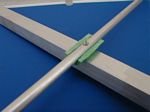
cheap solution. Final step shown on the picture is fixed to the 20x20 mm boom
with 3mm dia screw and secured with the washer and nut on the other side. Well
known design ground to the boom only the small portion (3 mm) of the element
instead of whole boom (20 mm) surface.
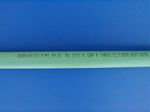
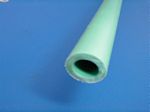
Buy the plastic pipe designed
for plumbing which can be found in any hardware or plumber store. Calculate the
overall length based on number of required insulators. Each insulator is 40mm
long, so for 10 elements yagi antenna you need at least 20cm
pipe.
Between many standard
dimensions take the one with 12mm inner diameter to alow 10 or 12mm element
diameter to be secured properly. For bigger diameters use the higher standard
measures. For smaller element
diameters like 8mm, 6mm use another method.
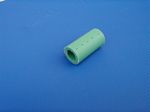
Cut the pipe in 40mm long
pieces (for 20mm boom), or 35mm (for 15mm boom). This length will ensure enough
strength to prevent rotation of the elements. Longer insulators a not required,
because of detuning effect, specialy on the 432Mhz and
higher.
3
4
5
6
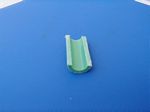
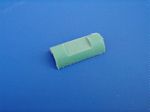
Cut the piece of pipe to
split the same in two identical pieces like shown on the picture. This step will
require precision in cuting to allow use of both splited parts. If not form the
required part with the file. Clear all edges with sharp knife.
Antenna insulators for DK7ZB antenna
builders
Depending of the boom size that you intent to use, form the
notch, to fit properly to the boom. Pay attention not to file notch more than
1-2 mm deep. This will ensure 2-3mm distance from the element to the boom, as
required. Notch should be 15 or 20mm wide.
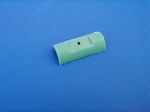
In the last step there is only one thing to do: drill the 3mm
hole exactly in the center of the insulator when later the screw will be
inserted. Run the 3mm screw through the element, insulator, boom and tight
everything with the nut on the other side.
By
9a4qv
Final note
Insulators presented here are in use on the 12 elements DK7ZB
version of the antenna for the 144Mhz for last 12 months. Up to now they are
showing very good characteristics considering machanical stability and
resistance to local weather conditions ( sun and salt ). I have no data sheet
with the plastic pipe characteristics where we can see how UV light can affect
plastic material. All I now is that this pipes are designed for temperatures up
to 100 °C. At the end, this is just one way, showing cheap approach to building
simple but very effective antennas.